
Think about the last time you tried to buy something online.
You didn't just Google it. You opened ten tabs, skimmed Amazon reviews, scrolled TikTok, ignored the "Top 10" listicle that was clearly an ad, doubted every influencer who turned up in your feed, and then texted a friend anyway. Because deep down, theirs is the opinion you actually trust.
It's not that there aren't enough options online. It's that everything useful is buried. Buried under paid placements, fake reviews, SEO'd listicles and algorithms that push what pays, not what's best.
And the recommendations we genuinely trust, from friends, group chats, mums, colleagues, that one person who always knows the good stuff, are scattered across WhatsApp threads, DMs and half-remembered conversations that vanish the moment the chat moves on.
That's the problem Karli Kujawa, founder of US-based Hili, is trying to fix.
TL;DR
- What it is: A social discovery app that lets you ask friends and trusted communities for product recommendations, and save them in one place
- Who it's for: People who already text a friend before buying anything, and want a better home for those conversations
- The problem it solves: The recommendations we trust most are stuck in messaging threads; the recommendations we see most are sponsored, gamed, or generic
- Why it matters: A genuine alternative to algorithmic discovery, built around how people actually decide what to buy
What is Hili?
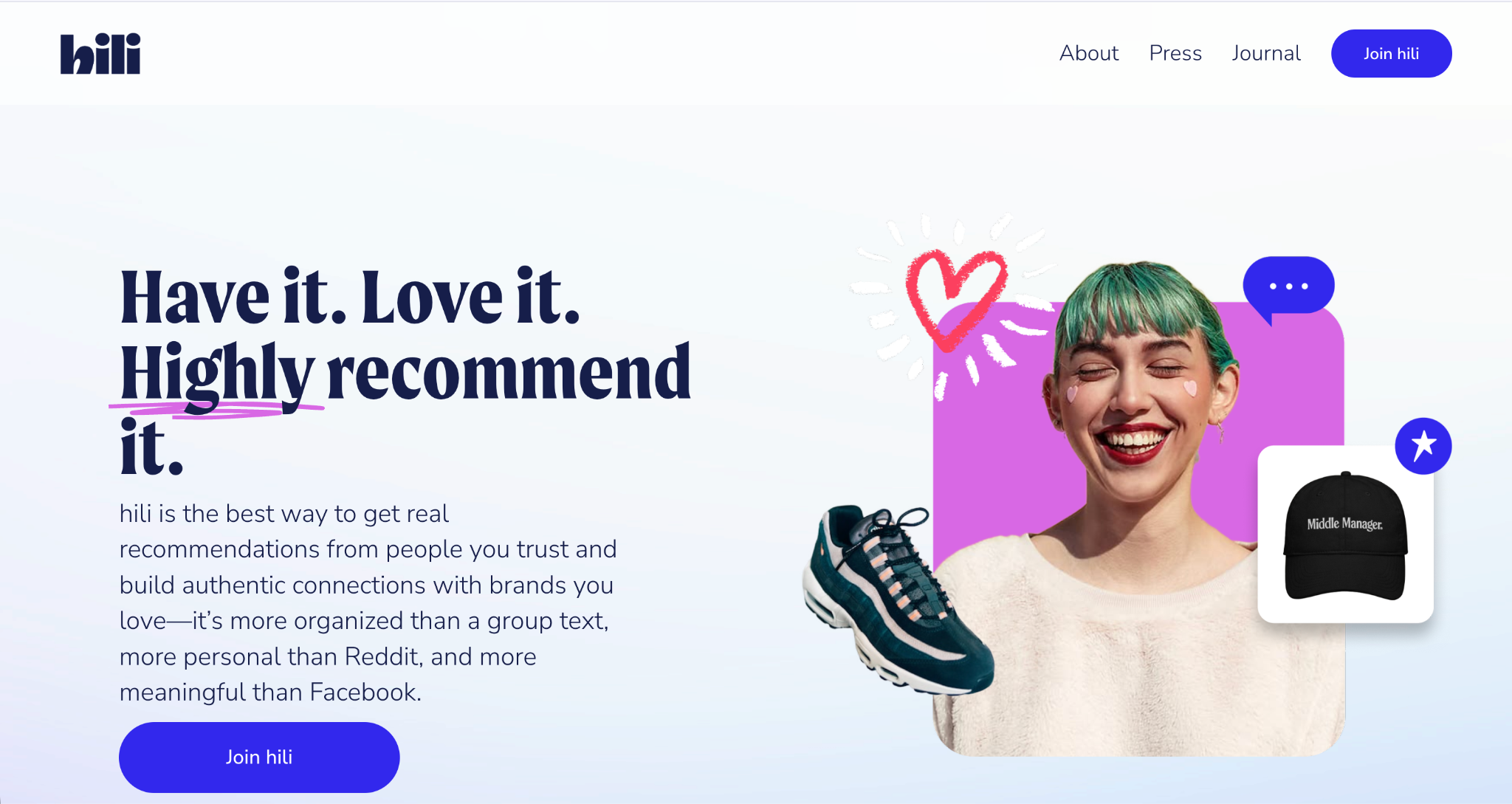
Hili is a social discovery app where you ask the people you trust for recommendations, and save the answers somewhere you can actually find them again.
The name is short for "have it, love it, highly recommend it." That's the whole product, more or less. You ask a question. Someone who's tried the thing answers. The answer doesn't disappear into a group chat. It lives on a card, with the link, with the reason it's worth knowing about, ready to be saved or shared the next time someone asks.
Future features include "spaces" (communities built around shared interests, from holiday travel to running a small business), a web clipper for saving things on the go, and a "trust graph" designed to surface recommendations from your network rather than from whoever's paid the most to be visible.
How does Hili work?
When you sign up, you're given three starting moves: ask, recommend, or save.
You can post an ask when you're after something specific. Best travel pushchair for a one-year-old. Plumber in Brooklyn. Skincare that does anything for adult acne. Friends and the wider community answer.
You can post a recommendation by dropping in a link. Hili scrapes the basic product info and turns it into a card, then asks you the bit that actually matters: why you love it. That short why-you-love-it note is the whole point. Star ratings tell you nothing. A sentence from someone whose taste you trust tells you everything.
And you can save anything you come across into collections, a kind of personal library of finds. Toddler gifts. Wines under $15. Hotels in places you've actually been. The more you use it, the more useful your collections become, and the easier it is to send someone the link your friend would have sent if they’d remembered to.
The model is built around connection, not commerce. Brands will eventually be invited onto the platform too, but only as named people, not faceless logos, and only as part of conversations users have started themselves. There are no ads pushed into your feed. No sponsored answers dressed up as organic ones. No agentic shopping bot pretending to know your taste.
Meet the founder: Karli Kujawa

Karli spent nearly twenty years in product strategy, design and branding before starting Hili. She worked at digital agencies, then in-house at high-growth startups, and most recently as Head of Design for Yahoo News.
The idea for Hili arrived in two pieces.
The first was a move from Chicago to Kansas City, where the indie brands and small makers she loved suddenly felt much harder to find. Online, every search seemed to loop her back to the same big-box names she already knew about. "There has to be a better way," she remembers thinking.
The second was reading Ed Zitron's 2024 piece The Man Who Killed Google Search, which set out, using emails released in the US Department of Justice's antitrust case against Google, how the company's search team came under pressure from its ads team to chase revenue over quality. For Karli, who had just been laid off by a big tech company and was already disillusioned with growth-at-all-costs culture, it was a kind of permission slip. The discovery problem wasn't her imagination. Big tech had broken it, on purpose, and someone needed to build the alternative.
So she started building it herself.
Why we love Hili
There's a particular kind of product that gets built when the founder is genuinely the user, and Hili is one of them. Karli isn't designing for an imagined customer. She's designing for the version of herself that texts three friends before booking a hotel.
What we keep coming back to is how clearly Hili sits on the side of the user rather than the advertiser. That's a rarer position than it sounds. Most platforms claim it; very few structure their product, their monetisation and their growth ambitions around actually meaning it. Karli is bootstrapping Hili, has set herself a hard ceiling of thirty employees, and is openly sceptical of any path that would force her to optimise for someone other than the person doing the asking.
The other thing worth saying: this is a product built on a really sharp read of behaviour. The recommendations we trust most have always come from people we know. The internet never quite figured out how to host that. Hili might.
We sat down with Karli to learn more about Hili, why she thinks the discovery problem is going to get worse before it gets better, and how she's building a product that puts the people you actually trust back at the centre of how you find things online. You can listen to the full conversation on The Discovery Call podcast on Spotify below.
Listen to the latest episode of Discover Startups